
RTP Explained: What 96% vs. 94% Really Means
Slot Math Made Simple
RTP Explained: What Return to Player Really Means in Slots
RTP is one of the most important numbers in online slots, but it is also one of the easiest to misunderstand. A slot with 96% RTP does not promise to return 96% of your money tonight. It describes a long-term theoretical average across a very large number of spins.
This guide explains RTP, house edge, 96% vs. 94%, why volatility still matters, and how to use RTP together with bankroll, playstyle, and game type.
Main Takeaway
It is a theoretical average, not a short-session prediction.
96% RTP means about 4% house edge. 94% RTP means about 6% house edge.
A 2-point RTP gap can make a big difference over large wagering volume.
RTP tells you the long-term math. Volatility tells you how bumpy the session may feel.
The Basics
What Is RTP in Online Slots?
RTP stands for Return to Player. It is usually shown as a percentage and describes how much a game is designed to return to players over a very large number of spins.
96% RTP means that for every $100 wagered in total, the game is theoretically designed to return about $96 over the long run.
The remaining $4 is the casino’s mathematical advantage, also called the house edge.
The key phrase is over the long run. RTP does not know your personal session, your budget, or whether you are playing 20 spins or 20,000 spins.
The Key Comparison
96% RTP vs. 94% RTP: Why the Difference Is Bigger Than It Looks
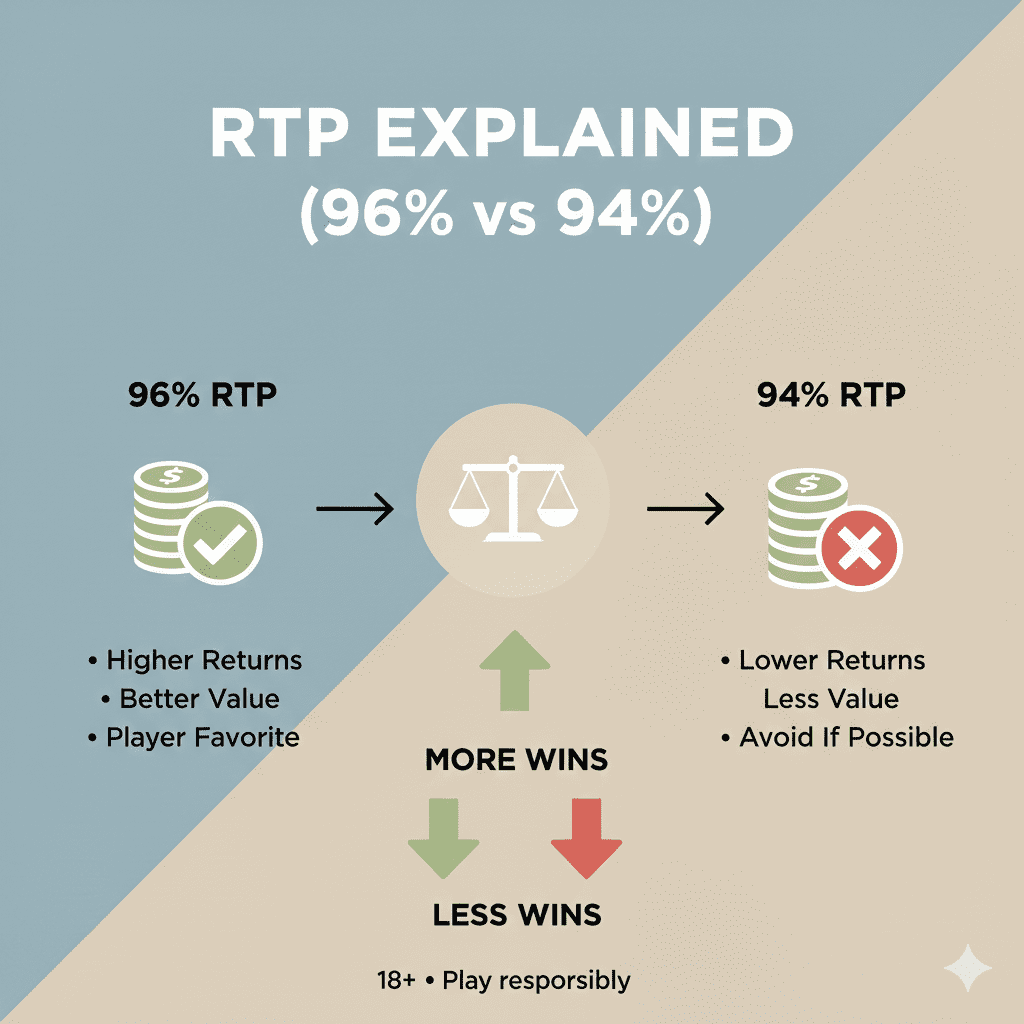
A 2-point difference sounds small, but the house edge comparison makes it easier to understand.
4% House Edge
For every $10,000 wagered over time, the expected loss is about $400.
6% House Edge
For every $10,000 wagered over time, the expected loss is about $600.
The practical difference
At $10,000 total wagered, the expected cost difference is about $200. That does not predict your exact result, but it shows why RTP matters more as your total play volume grows.
The Missing Piece
RTP vs. Volatility: They Are Not the Same Thing
RTP and volatility work together, but they explain different parts of the slot experience.
RTP tells you the long-term return model
RTP helps compare the expected mathematical cost of different games or different versions of the same game. It becomes more meaningful over larger total wagering volume.
Volatility tells you how swingy the ride may be
A high-volatility slot can have a good RTP but still create long dry stretches. A low-volatility slot may feel smoother, even if the headline RTP is similar.
Simple rule
- Short sessions: volatility usually matters more than RTP.
- Longer play volume: RTP becomes more important.
- Jackpot games: expect bigger swings, even when RTP looks acceptable.
Choosing Games
Should You Always Choose High RTP Slots?
In pure math terms, higher RTP is usually better than lower RTP. But RTP is not the only thing that matters. The better question is: does this game’s RTP, volatility, bet size, and feature structure fit your bankroll?
Choose High RTP When…
- You are comparing similar slots.
- You plan longer sessions or higher total wagering volume.
- You want to avoid obviously poor RTP versions.
- You are learning how game math affects expected cost.
Do Not Ignore Volatility When…
- You play with a small bankroll.
- You dislike long dry streaks.
- You are choosing jackpot or bonus-heavy slots.
- You want steadier sessions rather than big swings.
Game Types
How RTP Connects to Different Slot Types
RTP is not a standalone decision. It should be read together with the type of slot you are playing.
Classic Slots
Classic slots are usually easier to understand, but you should still check the game rules and paytable.
Progressive Jackpots
Jackpot games can be exciting, but part of the game math may be tied to the jackpot structure.
High Limit Slots
With larger bet sizes, small RTP differences can become more expensive faster.
Bonus Rounds
Free spins, multipliers, bonus buys, and special modes can affect how the game feels in practice.
Before You Play
Quick RTP Checklist
Check the game info screen
Look for RTP inside the paytable, game rules, help menu, or info icon.
Look for multiple RTP versions
The same slot name may be offered in different RTP configurations by different casinos.
Match RTP with volatility
High RTP does not automatically mean frequent wins or smooth gameplay.
Watch bet size and bankroll
The higher your total wagering volume, the more RTP differences can matter.
Be careful with bonus modes
Bonus buys and special features may change the game experience and risk profile.
Use limits
Set a budget and time limit before playing, especially with high-volatility games.
Common Mistakes
RTP Myths to Avoid
“96% RTP means I get 96% back.”
No. It is a long-term theoretical average across a huge number of spins, not a personal refund rate.
“Higher RTP always means more frequent wins.”
Not necessarily. Win frequency depends on volatility, paytable structure, and bonus mechanics.
“If I play long enough, the slot must even out.”
The game does not owe you a correction. Longer play makes the math more relevant, but it does not guarantee a specific result.
“High RTP makes a risky slot safe.”
No. A high-RTP slot can still be extremely volatile and require a bigger bankroll to handle swings.
How to Use RTP the Smart Way
RTP is best used as a comparison tool, not as a prediction tool. Start by understanding RTP, then combine it with volatility, slot type, bet size, and responsible limits.
RTP FAQ
What does RTP mean in slots?
RTP means Return to Player. It is the theoretical percentage of total wagers that a game is designed to return to players over a very large number of spins.
Is 96% RTP better than 94% RTP?
Mathematically, yes. 96% RTP means about 4% house edge, while 94% RTP means about 6% house edge. In short sessions, however, randomness can dominate the result.
Can the same slot have different RTP at different casinos?
Yes. Some providers release the same slot in multiple RTP versions, and casinos may choose which version to offer.
Does high RTP mean low volatility?
No. RTP and volatility are different. A slot can have high RTP and still be highly volatile, with long dry stretches and bigger swings.
What RTP should I look for?
Many online slots sit in the mid-90% range. Higher is generally better when comparing similar games, but RTP should always be considered together with volatility and bankroll.
Does RTP matter in free slots?
Free slots are useful for learning features, pace, and game style. RTP is more relevant when real-money wagering is involved, but understanding it helps you compare slot math more clearly.
Compare Slots Before You Play
RTP is only one part of the picture. Use it together with volatility, game type, bankroll, and responsible limits.